
Oats Situation and Outlook
- Monday November 26, 2007
This analysis featured in the eptember 18, 2007 issue of the HGCA's MI Prospects, Volume 10, Issue 12
The European oat crop is larger this year, as yields have generally improved. But after a succession of years of declining area and output oats are not in surplus.
The European oat market situation has been turned virtually inside out over the last two to three years. As recently as 2004 the EU used export restitutions on 0.4Mt of Scandinavian oats to balance supply and demand in a structural surplus situation. Exports have since declined (Graph 1). It is evident this year that but for bound import tariffs which may in any event be suspended for the crop year, the EU may have been a net-importer of oats.
continue
The tighter supply situation for oats, in contrast to that for other grains, is not the result of poor yields, but rather reduced sowing of oats by almost all the major EU oat producers. In addition, the reduced sowing occurred at a time when prices appeared to be favourable relative to other grains.
Between 2002 and 2005 the EU-25 area sown to oats declined by about 20%, or 0.35Mha to 2.647Mha, with cutbacks in all the major oat producing countries (Graph 2). Despite oat prices at favourable levels relative to other cereals during most of the 2005/06 and 2006/07, a recovery in area and output has, the UK apart, been muted. Hypothetically the EU’s 0.4Mt structural surplus is produced from 0.125Mha. However, with the area reduced by several times this, the supply and demand balance has naturally tightened dramatically.
continue
What came as a surprise to most market participants, however, was the relatively inelastic nature of demand for oats as a livestock feed. The general supposition was that, as supplies of other nutritionally suitable livestock feeds were more than adequate, they would be readily substituted for oats, thus increasing availability for milling for human consumption. This has proven not to be the case over the last few years with milling oats at times trading at substantial premiums to feed wheat and barley.
Germany has a significant oat milling industry and with the decline in oat production, Germany has been increasingly dependent on imports, mainly from Sweden and Finland. These have in recent years consistently exceeded 0.1Mt. It was increased buying by German millers of Scandinavian oats which pushed oat prices up a few weeks ahead of more general cereal price increases in late August and early September.
While European oat prices have backed off somewhat, they are still at levels that appear to reflect a tight supply situation for milling as opposed for feed. If German millers need to return to the market to secure further supplies, prices could firm in late winter or early spring. Eventual assessment of crop quality will likely determine this.
The anticipated lifting of cereal import tariffs for the balance of the season, as the EU Commission is believed to be planning to recommend to the Agricultural Council, would likely cap any such price advances. The impact of lifting import tariffs on wheat, barley and maize would be very limited as due to the recent increases in world prices, variable tariffs have fallen dramatically. But for oats the tariff is bound at a fixed rate of €87.00 / t.
Canada appears to be the only potential external source of oats for the EU with supplies in the region of 0.5 to 0.6Mt above its currently anticipated export and domestic needs. However, with very high ocean freight costs and prevailing prices in Canada and the EU, the EU would not at present appear to be a realistic market even if import tariffs were eliminated. A year ago, however, when freight rates were lower, Canada exported 37,000t to Norway.
Looking ahead to next year, the chance of a major increase in the area sown to oats next spring seems limited. Even with set-aside provisions lifted and added area available for sowing, market prices appear to favour other cereals. German import requirements will likely continue to set the tone for the European market. Although Sweden and Finland are the primary source for German millers, neighbouring Poland, the largest producer of oats in the EU, may eventually become an alternate source. To date, however, German imports of Polish oats have been restricted to small shipments, probably destined for local feed markets.
UK Situation - Although oat prices were relatively favourable again last year, improved malting barley prospects probably limited the increase in UK oat sowing. At 0.129Mha, the sown area was up 7% and the largest since 1985. Yields, however, were down 7%, resulting in a crop of 0.726Mt, slightly below 2006. With beginning stocks also similar to a year ago, the supply situation looks similar to 2006/07.
continue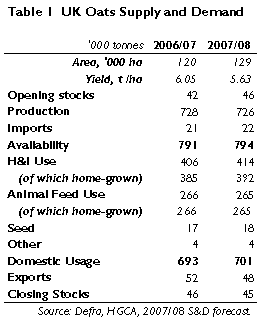
There are some differences, however, in terms of quality between the two crops. In 2006 the quality of the early harvested winter crop in southern England was good, while further north crops suffered from rain delays at harvest. This year many crops in south western England suffered from crown rust resulting in light weight grain not suitable for milling. The better quality crops were generally further north.
While the crop is large relative to recent trends in production, it is not exceptional in the context of milling oats consumption which is projected at 0.414Mt (Graph 3). The last two back-to-back crops of more than 0.7Mt were in 2002 and 2003, at which time prices were discounted to the degree necessary to find feed markets elsewhere in Europe. The limited UK price information available suggests that this has occurred to some degree this year, although quality may also have been a factor.
continue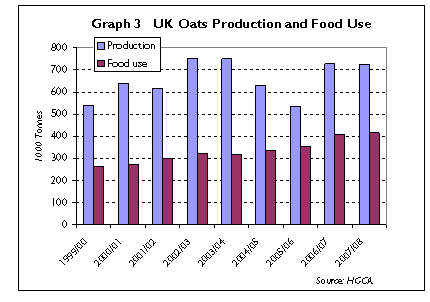
It is understood that UK oat millers have in recent years increased their level of contracting with farmers. A repeat of the situation in 2005/06, when, after farmers reduced oats production due to poor prices, UK millers found themselves competing with German millers for limited supplies of Scandinavian oats, is not anticipated this season.
David Walker 001 780 434 7615
top of page